The internal market is the heart of today’s Union. The Treaty establishing the European Community (the EC Treaty) provides for the activities of the Community to include "a system ensuring that competition in the internal market is not distorted" and "the approximation of the laws of Member States to the extent required for the functioning of the common market". ( The main steps to setting up the internal market see further information Annex 1. )
It should be noted that tariffs and quotas had been abolished at the end of the 1960s in the frame of the Customs Union and common commercial policy (meaning at external commercial relations) of the Union, but many technical and administrative obstacles to free trade still persisted. In order to abolish all technical, regulatory, legal, bureaucratic, culture and protectionist barriers of the European Union, the Member States and the institutions adopted hundred of Directives in seven years from 1985 to create free trade and free movement within the Union.
When these obstacles are removed and national markets opened, more firms can compete against each other. This means lower prices for the consumer – with the added bonus of a greater choice of goods and services. Firms selling in the single market know they have unrestricted access to more than 450 million consumers in the European Union - enabling them to achieve economies and efficiencies of scale, which translate in turn into lower prices. The single market has created 2.5 million new jobs since 1993 and generated more than €800 billion in extra wealth. The removal of national restrictions has enabled more than 15 million Europeans to go to another EU country to work or spend their retirement. People can move around more freely for work because Member States recognise many of each other’s academic and professional qualifications and they have built up a common coordination system for social regimes.
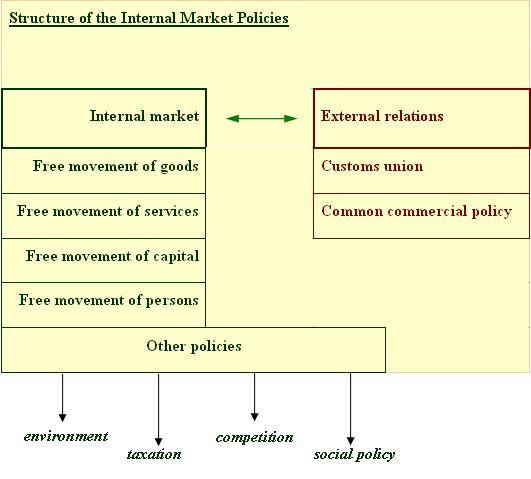
The movements of four freedoms – for goods, services, people and capital – cover a large area, and are surrounded by a range of supporting policies of the internal market, such as anti-trust policy, state aid policy, public procurement, environmental policy, social policy, taxation.
As the result of the creation of the single market EU Member States have liberalised previously protected
monopoly markets for utilities such as telecommunications, electricity, gas and water. Not just big industries, but households and small and medium sized businesses are increasingly able to choose who supplies them with electricity and gas on the basis of the best service and best price.
But there are further steps to be done. The services sector, for instance, has opened up more slowly than markets for goods, especially the financial services sector. But there should be further efforts in the field of transportation, where separate national markets still exist, especially for rail and air transport.
There are still some administrative and technical barriers to the free circulation of goods and services (the so called “ red tape”) which should be eliminated in all levels and in all cases. Common approach and willingness is necessary in the application of some common principles for example to accept each other’s standards and norms or to recognise the equivalence of professional qualifications in each and every case. The different national taxation rules also puts a brake on market integration and efficiency, since only indirect taxation in the field of VAT and excise-duty is harmonised within the Union while direct taxation remains under the national legislative power of the Member States.
|
Steps of the economic integration Free trade area = no visible trade restrictions Customs Union = free trade area (internal part of the Customs Union) and common external policy (common commercial policy towards third countries – external part of the Customs Union) Common market = Customs Union and free movement of goods (no trade restrictions at all in the goods market) Internal market = common market and no trade restrictions at all in the free movement of services, capital and workers Monetary union = internal market and common currency Economic union = monetary union and common economic policy |
|
Definitions: red tape = administrative and technical barriers to the free circulation of goods and services
monopoly = company that has complete control of the product or service it provides because it is the only company provides it
freedom of movements of goods, services, people and capital = One of the great achievements of the EU has been to create a frontier-free area within which (I) people, (2) goods, (3) services and (4) money can all move around freely. This is sometimes called “the four freedoms”. |
Problem solving with the internal market
The complex nature of the internal market legislation raises interpretation problems. Within the EU institutional framework it is the European Court of Justice to interpret the Acquis communautaire while the institutions and Member States are to apply them. However in the every day life there is a need to solve problems in a practical and quick manner, therefore the alternative problem solving measures have a strong added value.
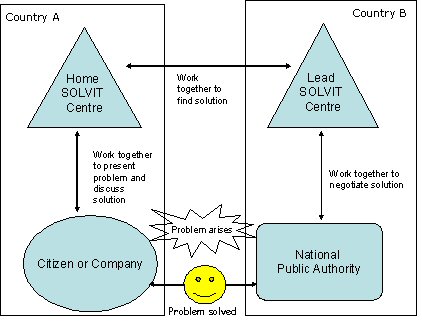
For these purposes on the initiative of the European Commission an on-line problem solving network, the so called SOLVIT was established in 2002. In this network system the EU Member States work together to solve without legal proceedings problems caused by the misapplication and misinterpretation of Internal Market legislation by public authorities. There is a SOLVIT centre in every European Union Member State and in the countries part of the European Economic Area ( Norway, Iceland and Liechtenstein). SOLVIT centres help with handling complaints from both citizensand businesses. They are part of the national administration and are committed to providing real solutions to problems within ten weeks. SOLVIT is an alternative dispute resolution mechanism. Since SOLVIT is an informal approach to problem solving it should not be used in situations where legal proceedings are already underway. SOLVIT is free of charge.
The problems arising in course of the application of the internal market legislation are often because of a lack of information about the rights of citizens and businesses in Europe and about how procedures work in other EU Member States. In such cases, the "Your Europe" portal on the Europa website can help to clarify matters. The other obstacle could be that the national authorities do not apply properly the national rules in the case of other Member States citizens or businesses. If you feel so, the SOLVIT system is there to help you. See more information about the working method, the procedures and the scope of the SOLVIT problem solving system on the homepage of the SOLVIT. Use it, if you need it.

SOLVIT has dealt for example with recognition of professional qualifications and diplomas, access to education, residence permits, voting rights, driving licences, motor vehicle registration , establishment as self-employed, public procurement, and taxation.
| Previous chapter | Next chapter |