
The three major sources of Community Law are (1) the founding Treaties, the so called primary legislation, (2) the secondary legislation adopted by the European institutions the Commission, the Council and the Parliament, and (3) the judicial legislation including the general principles of the Acquis communautaire shaped by the European Court of Justice.
|
Definitions Acquis communautaire = This is a French term meaning, essentially, "the EU as it is" – in other words, the rights and obligations that EU countries share. The "acquis" includes all the EU's treaties and laws, declarations and resolutions, international agreements on EU affairs and the judgments given by the Court of Justice. It also includes action that EU governments take together in the area of "justice and home affairs" and on the Common Foreign and Security Policy. "Accepting the acquis" therefore means taking the EU as you find it. Candidate countries have to accept the "acquis" before they can join the EU, and make EU law part of their own national legislation. Source: http://www.europa.eu.int/abc/eurojargon/index-eu.htm See more on: http://www.europa.eu.int/scadplus/glossary/index-eu.htm
|
(1) The Treaties adopted by the Member States of the European Union
- the primary legislation - (a) founding Treaties, (b) amendments of the founding Treaties, (c) accession Treaties of the new Member State
The Treaties adopted by the Member States constitute the European Union’s ‘primary legislation, which is comparable to constitutional law at national level.
The Treaties are the foundation for everything the European Union does. Thus, they lay down the purpose of the European integration, the main objectives, the fundamental features of the Union, the basic values of the Union, the responsibilities of the various institutions involved in the decision-making process, the legislative procedures, the legal norms and the Community’s policies.
All Treaties were formed with a view of achieving the same fundamental objectives: the construction of an organised Europe, an ever closer union among the people, and a common effort to promote the well-being of their citizens. All Treaties share the broad objective of market integration. Even as the original goal of the EC Treaty was, as its name implies, primarily economic, so it is in the widest sense.
Common features of the Treaties adopted by Member States:
(a) The Community has three founding Treaties and the Union has one.
The founding Treaties of the Community
The main purpose of the EC Treaty was to bring about the gradual integration of the States of Europe and to establish a common market founded on the four freedoms of movement (for goods, services, people and capital) and on the gradual approximation of economic policies.
The aim of the Euratom Treaty was to coordinate the research programmes already undertaken or planned by the Member States for the peaceful use of nuclear energy. This treaty has now in a sense been absorbed into the EC Treaty.
The founding Treaty of the Union:
The EU Treaty pursues two main objectives: the creation of a monetary union by laying down the principles and arrangements for the introduction of the Euro and the creation of an economic and political union. This is the Treaty that originated the concept of a three-pillar structure, the first pillar consisting of the European Community and the other two of the common foreign and security policy and police and judicial cooperation in criminal matters. There is, however, a big difference between the first pillar and the other two, which have not given rise to any transfers of sovereignty to the common institutions as was the case with the Treaty establishing the European Community. In these fields the Member States wished to preserve their independent decision-making powers and restrict themselves to an intergovernmental form of cooperation, while in the first pillar the Community method should be applied. The EU Treaty changed the name of the European Economic Community (EEC) to European Community (EC), while the other two Communities, the ECSC (see were merged with that Community. ECSC Treaty) and Euratom (see Euratom Treaty)
(b) Amendments of the founding Treaties:
The present EC Treaty and the EU Treaty are results of the amendments made by the Member States over the years. The EC treaty has been amended several times. These amendments were in line with the changes in the integration process, with the willingness to have a closer unity among the Member States.
As a result of these amendments, the domain of the EC Treaty has been extended so that they now include nearly all aspects of the economy and certain special political matters, such as the right of asylum and immigration.
Constitution for Europe
When the modification of the current Treaties are listed the Constitution for Europe (European Constitution) is to be mentioned, signed in Rome on October 24, 2005 by the current 25 EU Member States and the two coming Member States, Bulgaria and Romania.
The Constitution for Europe is the complete revision of the current Treaties, designed to replace and unify them. The ratification process of the Constitution for Europe is currently in progress. However taking into account the negative referendums placed on it by France and the Netherlands, the exact future of the Constitution can not yet be foreseen.
Procedure to adopt and modify the Treaties and the rules concerning their entry into force:
The founding Treaties and their amendments is the subject of direct international negotiations between the governments of the Member States. Whenever the Treaties have to be reviewed and amended, it is done by a special conference of the Member States’ national governments by an “inter-governmental conference” (IGC). The founding Treaties and their amendments are to be ratified in accordance with the constitutional procedures of the Members States (in principle by the national parliaments or by referendum). After the ratification in all Member States the Treaty comes into force.
(c) Accession Treaties of the New Member States
The Treaties have also been amended each time new Member States have joined the European Union. These modifications of the Treaties are also part of the primary legislation of the Union, laying down the conditions of the accession of the new Member States.
The European Union has been enlarged five times: the six founding members (Belgium, Germany, France, Italy, Luxembourg and the Netherlands) were joined in 1973 by Denmark, Ireland and the United Kingdom, in 1981 by Greece, in 1986 by Spain and Portugal, in 1995 by Austria, Finland and Sweden and in 2004 by the Czech Republic, Estonia, Cyprus, Latvia, Lithuania, Hungary, Malta, Poland, Slovakia and Slovenia.
Conditions to become a Member State of the European Union
According to the EU Treaty any European country is allowed to apply for EU membership, if it is a functioning democracy, it respects the human rights and the rule of law.
In the course of the history of the European integration additional conditions were set up. For example in the case of the latest enlargement, the EU Member States adopted the Coppenhagen criteria to be fulfilled by the applicant countries. These criteria are:
The Treaty established a procedure of accession of a new Member State. According to Article 49 of the EU Treaty the Applicant country shall address its application to the Council, which shall act unanimously after consulting the Commission and after having received the assent of the European Parliament, which shall act by an Absolute majority of its component members. The conditions of the admission and the adjustments to the Treaties which the Union is founded shall be subject of an agreement between the Member States and the Applicant country . This agreement shall be submitted for ratification by all the contracting parties according to their constitutional rules.
|
Definitions Acceding country = This is a candidate country that has met the Copenhagen criteria and completed negotiations for joining the European Union. (At present: Romania, Bulgaria) Applicant country = This means a country that has applied to join the European Union. Once its application has been officially accepted, it becomes a Candidate country . Candidate country = This means a country that has applied to join the European Union and whose application has been officially accepted. At present there are two candidate countries: Croatia and Turkey. Before a Candidate country can join the EU it must meet the ' Copenhagen criteria '. Copenhagen criteria = In June 1993, EU leaders meeting in Copenhagen set three criteria that any Candidate country must meet before it can join the European Union. First, it must have stable institutions guaranteeing democracy, the rule of law, human rights and respect for minorities. Second, it must have a functioning market economy. Third, it must take on board all the acquis and support the various aims of the European Union. In addition, it must have a public administration capable of applying and managing EU laws in practice. The EU reserves the right to decide when a Candidate country has met these criteria and when the EU is ready to accept the new member. Member State = The countries that belong to an international organisation are its '
Member States'. The term is also often used to mean the governments of those countries. Third country = This phrase simply means a non-EU country. The meaning is clearest when we are speaking about relations between two EU Member States (or between the EU institutions and a Member State) and another country - literally a Third country - that is outside the European Union. Source: http://www.europa.eu.int/abc/eurojargon/index-eu.htm See more on: http://www.europa.eu.int/scadplus/glossary/index-eu.htm |
(2) The secondary legislation of the Community
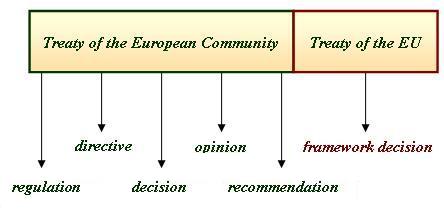
The secondary legislation is a product of the EU institutions. The EC Treaty defines the secondary legal sources, and the decisions making-mechanism to be applied in order to achieve the common goals of the Member States. It is to be mentioned that the Treaties have a framework characteristic laying down the competences of the EU, determining the objectives and the scope of the EU’s power. In addition the Treaties determine the means to implement the rules by adopting secondary legislation of the institutions. The significance of the secondary legislation can be underlined by the fact that the Council and the Parliament adopt about 500 pieces of EU legal norms every year, while the Commission adopts around 1500 annually.
The term Community legal instruments refers to the instruments available to the Community institutions to carry out their tasks under the Treaty establishing the European Community with due respect to the Subsidiarity principle.
Article 249 of the EC Treaty defines these legal instruments, the secondary legal norms, and differentiates between them on a binding and non-binding legal basis. According to the Treaty the EC institutions shall make regulations, issue directives, take decisions, make recommendations or deliver opinions. Regulations, directives and decisions to whom they concern are the so call binding legal norms, while recommendations and opinions are non binding legal acts.
A regulation shall have general application. It shall be binding in its entirety and directly applicable in all Member States. This means that Member States are not obliged to issue national legal acts in order to apply the regulation. They have to apply a regulation as such from the entry into force of that regulation. Regulations contain precise and detailed rules usually in the common policy areas such as agricultural policy, competition policy, Customs Union.
A directive shall be binding as a result to be achieved, upon each Member State to which it is addressed, but shall leave to the national authorities the choice of form and methods. It means that Member States have an obligation to transpose the directives into national law, by adopting national transposition measures. The directive in its final provisions states the transposition deadline of the national measure. The deadline ensures that the directive is applied in every Member State from the same date. It is important that the Member States equally apply the Acquis communautaire , equally transpose the directives and adopt national implementing measures. Therefore the European Commission closely monitor the transposition of the Member States and starts infringement procedure against them if they breach the obligation of the membership. The purpose of the infringement procedure is to force Member States to correctly apply the acquis. At the end of the infringement procedure the European Court of Justice is going to decide about the breach of the European law. The European Commission twice a year in the internal market scoreboard monitors the transposition data of the Member n erefore the European Commission closly al dline of the national measure. The common dea States and provides statistics for the highest political level of the European Union, for the European Council. The transposition deficit is the euro-jargon for the directives not been transposed during a period of time. The transposition deficit is the lack of timely and proper implementation of directives by a Member State.
A decisions shall be binding in is entirety upon those to whom it is addressed. It is an individual act. Decision can be issued by the Council, jointly by the Council and the European Parliament, by the European Commission or by the European Central Bank in the areas defined by the EC Treaty. Decisions are usually in administrative nature or contain implementing measures of another secondary legal act. Decisions are often adopted by the European Commission in competition policy matters concerning antitrust or state aid cases.
The EU has its own Official Journal for the official publication of legal norms.
The regulations, directives and decisions shall be published in the Official Journal of the European Union (OJ). The Official Journal of the EC is published in all official languages of the EU at the same day. It has two different series the L and the C series and a special S series for the publication of the EU level public procurement tenders. It should be mentioned that this latter is currently only available in an electronic form through the internet as a supplement to the Official Journal.
The EC legal norms should enter into force on the date specified in them or, in absence of thereof, on the twentieth day following their publication in the Official Journal. As directives shall be transposed into the national legislation they shall be notified to the European Commission. Directives enter into force on the date specified in them or, in absence of thereof, on the twentieth day following their publication in the Official Journal but they shall take effect upon the transposition deadline.
In addition to the type of legal norms studied above the secondary legislation chapter the European Commission has worked out new type of norms not be found in the Treaties. These belong to the so-called soft law. For example it uses the form of guidelines, notices, comfort letters. The guideline gives a picture on a special development field. The notice explain the Commission understanding in a special field of Community policy. The comfort letters are assurance for example that the competition rules will not be enforced against an entity.
Among the preparatory documents the Green Papers of the European Commission should be mentioned which intends to stimulate thinking and launches consultation at European level on a particular subject. The consultations resulting from a Green Paper can then lead to the publication of a White Paper which proposes a set of concrete measures for Community action. The White Paper is followed by a Commission communication, which contains the legislative proposal.
Legal norms of the second and third pillar
The different nature of the second pillar (the common foreign and security policy) and third pillar (the justice and home affairs policy) of the European Union can be seen by the legal norms to be used in these fields.
Article 12 of the EU Treaty says that the Union shall pursue the objectives of the common foreign and security policy by defining the principles of and general guideline for the common foreign and security policy, deciding on common strategies, adopting joint actions, adopting common positions, strengthening systematic cooperation between Member States in the conduct policy.
In the field of justice and home affairs the EU Treaty lists four legal instrument to be used (Article 34 of the EU Treaty): common positions defining the approach of the Union to a particular matter; framework decisions for the purpose of the approximation of national legislation; binding decisions excluding any approximation obligation; conventions as international treaties to be adopted in a particular field by the Member States or a group of Member States.
(3) Judicial legislation- case law
The jurisprudence of the European Courts is the third and very important source of the Community’s legislation. It contains not only the decisions, judgments or orders of the ECJ but general principles and expressions of opinion. The cornerstones of the judicial legislation will be explained under the next chapter on the general principles of the Community law.
All the decisions handed down by bodies exercising judicial powers constitute case-law. The Court of Justice and the Court of First Instance of the European Communities are the judicial institutions of the European Union. It is the task of the Court to ensure that Community law is respected in the interpretation and implementation of the founding treaties
| Previous chapter | Next chapter |


