
Composition of the Council, the Council configurations
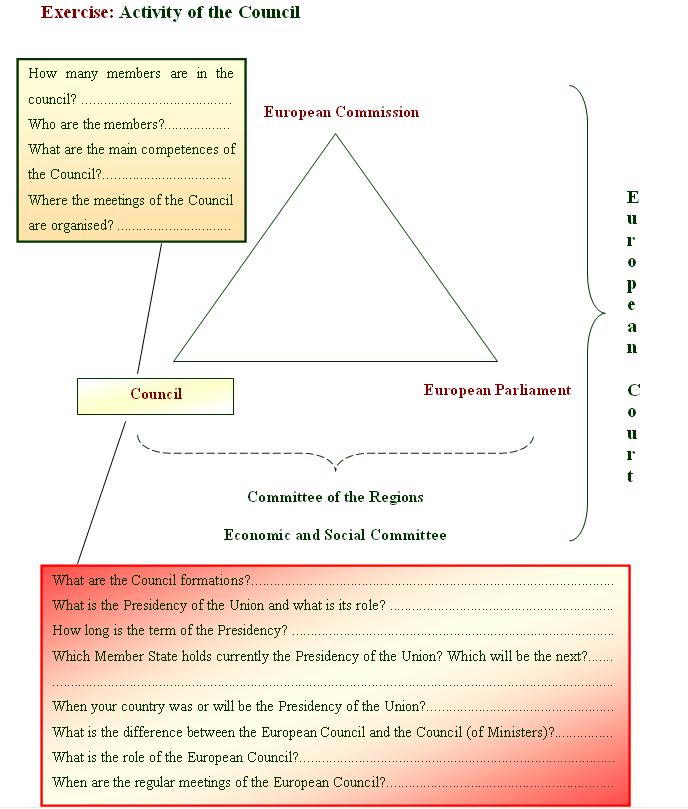
The Council of Ministers is the main legislative body of the EU. As an intergovernmental institution it represents the interest of the Member States. The Council at ministerial level is composed by one representative from each Member State, usually the responsible minister of the country. The name of the Council differs taking into account which subjects are discussed at the Council meeting. According to the different fields the following nine Council configurations can be listed:
In the Council the ministers represent their governments, the position of their governments. The agenda and the work of the Council at ministerial level is prepared by the Permanent Representatives Committee I and II (COREPER) composing of the heads (ambassadors – COREPER II) and deputy heads (COREPER I) of the Member States’ Permanent Representation delegated to the European Union. The COREPER meet weekly within the Permanent Representatives Committee (COREPER).
At a lower level, the working groups are responsible for the preparation of the positions. In the working groups the Governments’ are represented by their public administration. Already at this low level the objective is to find a consensus or at least Qualified majority on the proposal.
Responsibilities of the Council
The Council has six key responsibilities:
The working method and the voting system of the Council
The Council is assisted by the Secretariat General of the Council. The Council agenda is determined by the multiannual program of the council, by the Commission working program, and by the program of the Council Presidency.
Decisions in the Council are taken by vote. The Council may adopted its decision by three different types of voting: Simple majority, Qualified majority, Unanimity. In the case of Qualified majority voting, the votes are weighted according to the population of the Member States. However it is also a political deal between the heads of states and governments. In the Qualified majority voting three factors are to be fulfilled: (1) numerical threshold for majority of the votes 232 votes out of the total 321, (2) if the initiative comes from the proposal the adoption requires the supporting vote of the half of the Member States (13 Member States); (3) population filter requirement which means the possibility to ask for verification that at least 62% of the EU population is represented in the favourable decision.
The weight of votes by Member States:
Member States |
Weight of votes |
Germany , France, Italy and the United Kingdom |
29 |
Spain and Poland |
27 |
The Netherlands |
13 |
Belgium , Czech Republic, Greece, Hungary and Portugal |
12 |
Austria and Sweden |
10 |
Denmark , Ireland, Lithuania, Slovakia and Finland |
7 |
Cyprus , Estonia, Latvia, Luxembourg and Slovenia |
4 |
Malta |
3 |
TOTAL |
321 |
In the case of the Unanimity voting each Member State has one vote, and therefore the power of veto. Unanimity is maintained in particularly sensitive areas such as Common Foreign and Security Policy, taxation, asylum and immigration policy.
|
Definitions:
Presidency of the Union = it is held in turn on a six-monthly basis by each
Member State. A stint in the Presidency is a duty and a contribution that each
Member State makes to the proper functioning of the Community institutions. Each EU country in turn takes charge of the Council agenda and chairs all the meetings for a six-month period, promoting legislative and political decisions and brokering compromises between the
Member States. 2006/I. Austria, 2006/II. Finland, 2007/I. Germany, 2007/II. Portugal, 2008/I. Slovenia, 2008/II. France , 2009/I Czech republic, 2009/II Sweden, 2010/I. Spain, 2010/II. Belgium, 2011/I. Hungary. Unanimity (in the Council of Ministers) = Unanimity means the obligation to reach a consensus amongst all of the Member States meeting within the Council so that a proposal can be adopted. Under the current Treaties the scope for Unanimity has been increasingly limited. Under the co-decision procedure, the Treaty makes provision for Unanimity in three cases (social security for migrant workers, recognition of diplomas if amendment of national legislation is required, and incentive measures in the field of culture). In addition, in other matters the Council must decide unanimously if it wishes to adopt a different position to that of the Commission. Qualified majority (in the Council of Ministers) = the threshold for a Qualified majority is currently be set at 232 votes out of 321 (72.27 %). The decision will also require a favourable vote from the majority of Member States (i.e. at least 13 Member States). In addition, a Member State may request verification that the Qualified majority includes at least 62% of the Union’s total population. Should this not be the case, the decision will not be adopted. Source: http://www.europa.eu.int/abc/eurojargon/index-eu.htm See more on: http://www.europa.eu.int/scadplus/glossary/index-eu.htm |
| Previous chapter | Next chapter |