
Group of the European People's Party (Christian Democrats) and European Democrats


Confederal Group of the European United Left - Nordic Green Left


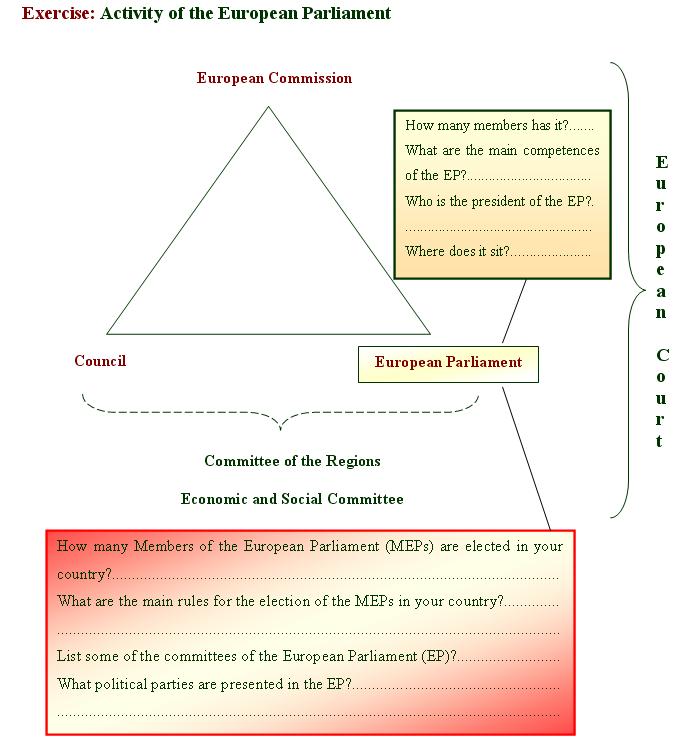
The European Parliament is the assembly of the representatives of the Union citizens, elected by direct universal suffrage every five year. Each Member State decides on the form its election will take, but follows identical democratic rules: a voting age of 18, equality of the sexes and a secret ballot. However there are some common principles for the EP elections: direct universal suffrage, proportional representation and a five-year renewable term.
Today, the Parliament has a total of 732 members, distributed between Member States with regard to their population. The seats are, as a general rule, proportioned out according to the population of each Member State. Each Member State has a set number of seats, the maximum being 99 and the minimum five. From 2009, the number of Members of the European Parliament may not exceed 750. The members of the Parliament work in political groups.
The Parliament works in Brussels or in Strasbourg. In Brussels there are the meetings of the parliamentary committees and political groups, and additional plenary sittings. In Strasbourg they attend 12 plenary sittings. In parallel with these activities they must also, of course, devote time to their constituencies.
The Members of the European Parliament are grouped by political affinity and not by nationality. 19 Members are needed to form a political group, and at least five Member States must be represented within the group. Members may not belong to more than one political group.
The number of the Members of Parliament:
Member States |
Number of the members |
Germany |
99 |
France , Italy and the United Kingdom |
78 |
Spain and Poland |
54 |
The Netherlands |
27 |
Belgium , Czech Republic, Greece, Hungary and Portugal |
24 |
Sweden |
19 |
Austria |
18 |
Denmark , Slovakia and Finland |
14 |
Ireland , Lithuania |
13 |
Latvia |
9 |
Slovenia |
7 |
Cyprus , Estonia, Luxembourg |
6 |
Malta |
5 |
TOTAL |
732 |
List of the current political groups:
|
Group of the European People's Party (Christian Democrats) and European Democrats |
|||
|
|
|||
|
|
|
||
|
|
|
|
|
|
|
|
Confederal Group of the European United Left - Nordic Green Left |
|
|
|
|||
|
||||
Main responsibilities
Each modification of the Treaties has increased the role of the European Parliament. It has become a co-legislator from the consultative player, has budgetary powers and exercises democratic controls over all the European institutions.

The European Parliament's main functions are as follows:
The organization of the Parliament
The Parliament elects its President for a renewable term of two and a half years, i.e. half the lifetime of a Parliament. The President ensures that Parliament’s Rules of Procedure are adhered. He or she is the representative of Parliament in legal affairs and in all external relations. The EP President and the President of the Council both sign all legislative acts adopted under co-decision. She or he delivers an opinion on all major international issues and makes recommendations designed to strengthen the European Union. At the beginning of every European Council meeting (summit) the President of the European Parliament sets out Parliament’s point of view and its concerns as regards the items on the agenda and other subjects. After the European Union’s budget has been adopted by Parliament at second reading, the President signs it, rendering it operational. The president is assisted by 14 vice-presidents.
There are 20 parliamentary (standing) committees. A committee consists of between 25 and 78 MEPs, and has a chair, a bureau and a secretariat. The political make-up of the committees reflects that of the plenary assembly .The parliamentary committees meet once or twice a month in Brussels. Their debates are held in public. The committees draw up, amend and adopt legislative proposals and own-initiative reports. They consider Commission and Council proposals and, where necessary, draw up reports to be presented to the plenary assembly.
Besides the standing committees the Parliament can also set up sub-committees and temporary committees to deal with specific issues, and committees of inquiry under its supervisory remit.
| Previous chapter | Next chapter |