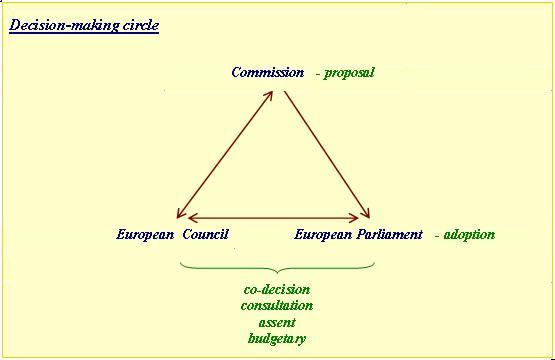
The decision-making mechanism of the European Union is a complex system. The institutions can only act within the scope of the powers conferred upon them. Community acts must clearly refer their legal basis within the Treaty. This is usually done in the preamble of the legal norm. In every case when the institutions have the power to enact legislation, the Treaty specifies the type of the legal norm to be made and the sort of the decision-making procedure to be applied. The Treaty points out the institutions to be involved in the adoption of the legal norm, whether it is the Commission, the Council or the Council acting with the Parliament jointly. The Treaty also specifies whether the legal norm should be adopted unanimously, by Qualified majority or by Simple majority within the Council.
In general, it is the European Commission that proposes new legislation, but it is the Council and Parliament that pass the laws. Other institutions and bodies also have roles to play according to the decision-making procedures. It should be noted that at the time of the Treaties of Rome it was the Council to adopted secondary legal norms. Through decades and hard efforts the Parliament could attain more rights in the direct participation of the decision-making. This led to an essential change in the role of the Parliament and currently in the frame of the most usual decision-making procedure the co-decision procedure - it is the co-legislator besides the Council. The stronger co-legislator role of the European Parliament is a significant step in the discussions of the democratic deficit of the European Union. The democratic deficit is a concept invoked principally in the argument that the European Union and its various bodies suffer from a lack of democracy and seem inaccessible to the ordinary citizen because their method of operating is so complex. The Maastricht, Amsterdam and Nice Treaties have triggered the inclusion of the principle of democratic legitimacy within the institutional system by reinforcing the powers of Parliament with regard to the appointment and control of the Commission and successively extending the scope of the co-decision procedure.
| Previous chapter | Next chapter |